Posts

The martial art around center-grip round shield and could we reconstruct it?
Image
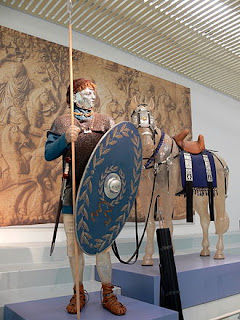
The Martial Art around center-grip shields The center-grip round shield was used in Europe for over a millennium. From Roman parma to vikings and even further, if one counts bucklers of later periods. The size of the shield and the context of usage varies, but the basic form of the center-grip shield remained the same from the Roman infantryman to Charlemagne's knights and late viking warriors. Weapons that were used with a parma were spear, lance, javelin, and sword ( gladius or spatha ). The original Roman parma was round in shape and most likely 90 cm in diameter. Quite similar to the largest viking age shields. It was first used by light skirmishing javelineers on foot (velites) , as well as by cavalry lancers (equites) in the Roman Republican period. The origins of the shield can be found in the Hellenistic period, and the Romans copied it from the Greeks, who used it for similar purposes, especially by Hellenistic cavalry. Even though the main shield of the legionary bec...
UNDERSTANDING THE SPEAR (and the overarm grip).

Image
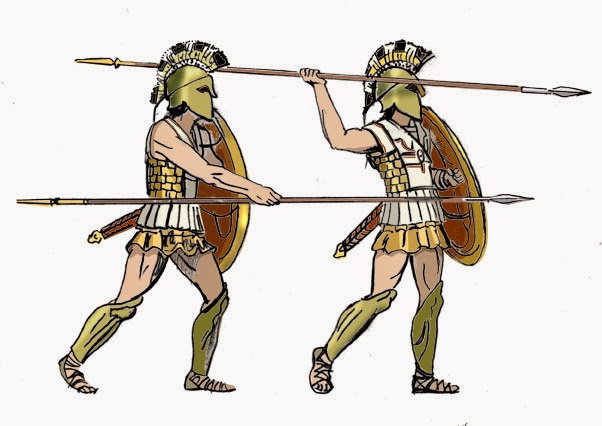
  It's been 12 years of training with a one handed spear for me (Arttu). Mostly I have trained weekly in summer time, but few years around the year. I started, and still continue, training with soft headed weapons in Finnish boffering scene. Also trained two handed pole weapons in HEMA context and one handed spear in Finnish reenactment scene. It took me 10 years before I became comfortable using a spear in the grip that is known as the overarm grip.    Underarm grip (left) and overarm grip Bef ore this I became ok with using the underarm grip. Here is a video of an accuracy drill. During my 10 year training I learned the sliding strike and to hold a long spear from the end of the shaft. I did not become comfortable in the overarm grip before I trained to throw the spear. (Here is an old, worst quality, training montage video .) There is a forever ongoing discussion about the grips that goes on in the armchair generals discussions of one handed spear fighting. To me the...

Servi Morituri, a gladiator performance. (How this all started.)

Image
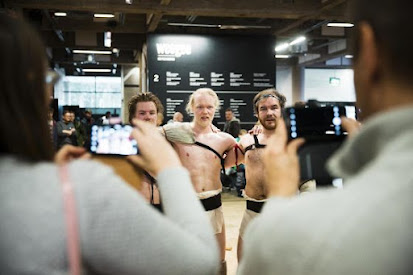
It was spring 2015 when the city museum of Espoo was planning on how to attract audience to its upcoming "Gladiators, Deaht and Glory" Presentation done together with the Colosseum museum of Rome. I (Arttu) am in a firm believe that it was the Idea of museum lecturer Tiuku Talvela to hire performers to create a gladiator fight show.  After a complicated recruiting shenanigans a team of three people was put together. A long time reenactor, a teacher of viking age reenacting combat and ancient artisan Julius Väliaho was chosen. With him a HEMA instructor and experienced stage combat performer Joeli Takala plus a dancer and choreographer with a background in martial arts Arttu Peltoniemi. Julius and Joeli had trained HEMA together in Grieswartt fencing club, and Arttu and Joeli had worked together in stage fight choreographs at the Finnish National Opera. The additional luck was in that everyone in the group had large and useful artisan skill set.  The preparations for the gladi...

An aproach on discovering historical fighting

Image
And how to train it Even though there is a lot of source material for 15th century HEMA, the quantity and details of descriptions become less when we dive deeper into the dark age and antiquity. We have thus far done a gladiator fight show as  Servi Morituri  for Espoo city museum, and a short movie presenting a late 9th-century fight  with Ruined Films. Both are of an era from where we don't have more than a couple of fragments to read about the fighting technique, so we have to go on discovering it through indirect ways. (Other less serious productions like this fantasy action flic HOME have also been done.) In Servi Morituri we approached the fighting trough contemporary art of the time, wounds in bones that are considered belonging to dead gladiators, writings of Galenos, later manuscripts explaining fighting on a similar kind of weaponry, and most importantly by inspecting and testing what kind of effects the gear has for fighting. Our stance is that having as ...

Fat little sister (making of a sturdy shield.)

Image
Prologue The first shield I made was planned around a hypothesis that in the area of Finland there is close to no shield finds, and thus it is believed the shields were made purely on organic material. The shield was highly inspired by a shield find from the swamp of Tira Latvia . After testing my thin, light, pretty, and agile thing that eats weapons, that are struct to it, deep into its board I decided to name it the Pale blade eater. (Go read about it here ) Now the context of a light shield is interesting. It is mentioned in the Egil Skallagrimssons sagas that Norwegians had stronger shields and thus were able to easily overpower Fins (Kareilians). I (Arttu) myself am not a strong man, and find the fast agile light shield superior in sparring, both with sharps in slowed down fighting and in fast phased fights using simulators and safety gear. Anyhow the sagas and most shield finds suggest a heavier shield was highly popular. So to find out how they compare we need one.  The ne ...

The Shield has lived few years now...

Image
If this shield is new to you please read the blog post of us making it here. So, the shield we made a few years ago has had some experience. We have shot arrows at it, thrown spears at it, and it has been part of slowed down sharp weapon fencing. Some things it endured better than others. Originally I (Arttu) wanted to try out how it holds together with only glue. I also wanted to cover only the face of the shield with animal hide, to show off with our radially cut planks. Hide on the face bent the shield a bit, so we changed the handle into a sturdier one. This made the shield straight again, but a bit heavier. Since the plan was to make as light a shield as we could, this was far from optimal. Shield bent with the first handle still attached. We tested the shield's integrity by throwing a spear at it multiple times. It took spear throws really well and due to its light structure the spear did not stick in the shield. We used a throwing spear made by JT Pälikkö. We took video of ...