Posts

The Spear Dance

Image
  Reimagining Prehistoric Dance and Experience To do the prehistoric “Spear dance” dance works, I read studies about the actual iconography and about the symbolism of the viking age. I am also a huge lover of Finnish and Nordic mythology and that has hugely influenced my performance. About the weapon dancer: https://bornholmarch.eu/wp-content/uploads/2020/04/A_storm_of_swords_and_spears_The_weapon.pdf About the symbolism by the incr edible Tomáš Vlasatý : https://sagy.vikingove.cz/en/friendship-with-the-god On this blog we have been mostly talking about recreating prehistoric fighting, but the interest of the group is much larger. In my (Arttu) work I have tried the same methods to recreating prehistoric fighting by creating an interpretation of prehistoric dance.  I have done 4 different performances on this subject. The first one was a solo dance where I improvised a set of material that imitated dancing in the stone age rock art. It was considered quite a success. I reprise...
Modest experience with wooden bosses

Image
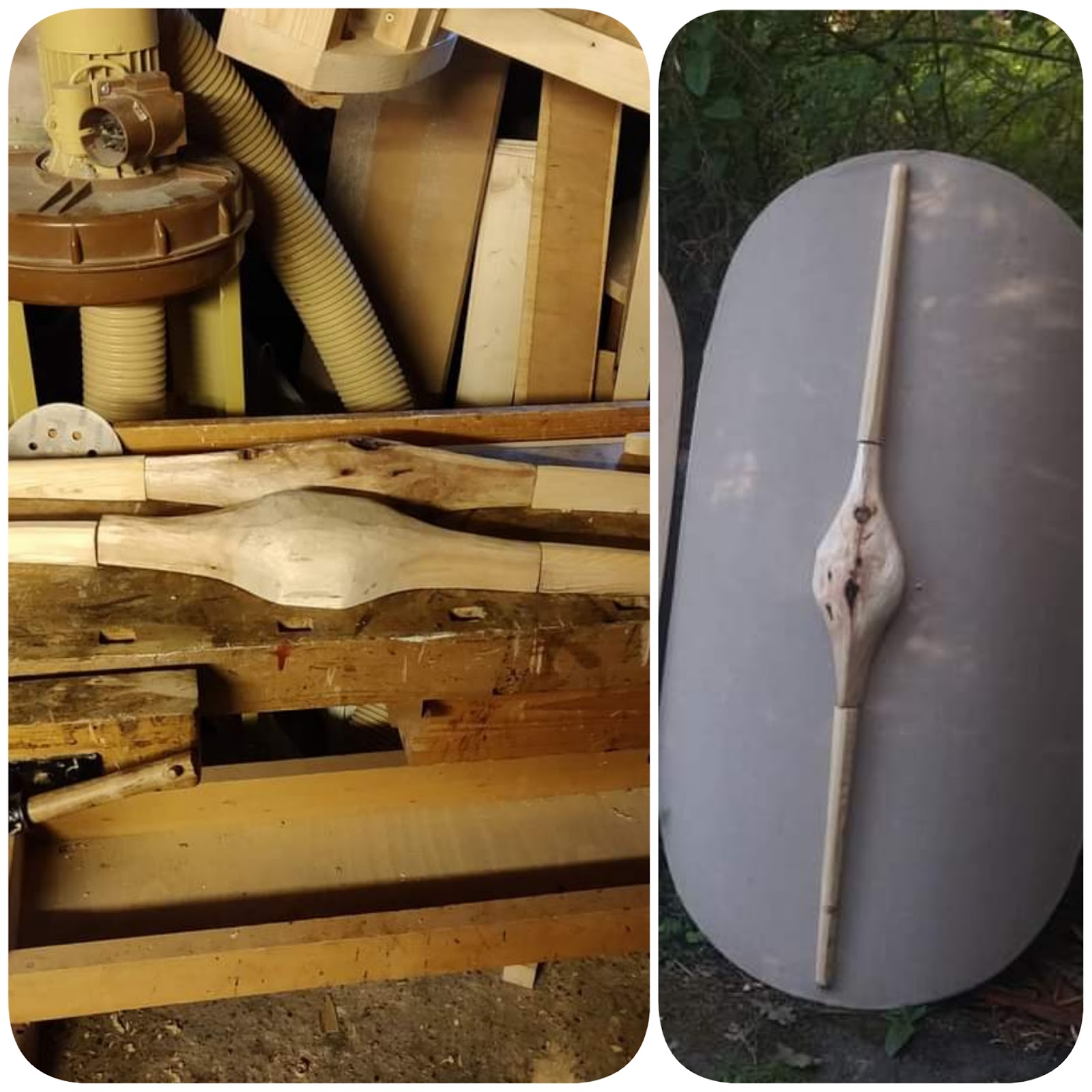
The inspiration for wooden bosses came originally from an article describing the Tira bog find. The firs shield we built was mostly inspired by this find. (Read about building the first shield here: https://hirdmenn.blogspot.com/2020/06/making-of-our-first-viking-shield.html ) In the making of our first shield we got a birch burl that I (Arttu) shaped first with power tools close to the finished shape and to give it an authentic finish I did the final shaping with an axe and chisels. The work was frustrating and I hated every moment. The wood was so hard that it did not want to cut in any direction, and was really unrewarding to work with. After the shape was ready it was rewarding to test it. In the first test we compared the wooden umbo to a plank a little thicker than it. The result was that the plank broke in two pieces, whereas the umbo got only a small arrow mark. Its first scar if you will. (See the first test here: https://youtu.be/jbnn0td5k70 ) Later among many of our test...

Simple fighting system for close distance spear use

Image
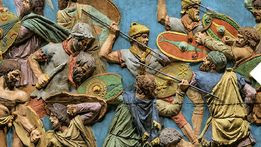
Coloured depiction of the Trajan column pointed to us by Martin Lysen when discussing the suggested system. We originally presented this Idea of fighting in this video: Techniques with scutum and spear , and in this blog post: https://hirdmenn.blogspot.com/2022/11/the-martial-art-around-center-grip.html   We have written about the sparring gear in this post: https://hirdmenn.blogspot.com/2022/11/the-martial-art-around-center-grip.html I often hear people saying that the spear's advantage is reach. This is true. It is often paired with the thought that the spear fighter should therefore maintain the distance. This is situational. My argument is that in fighting, one wants to be able to close the distance with any weapon they are using, as one wishes to have the ability to stand their ground. I am therefore claiming that in many situations the main benefit of the reach of the weapon is not that the enemy can't reach you, but that your longer reach gives you the initiative. About...

Weight of a center grip shield

Image
As one travels the swamps of academic research and in the hills of reenactor discussions on the internet... One learns to know a lot of common opinions about stuff. One common opinion is that shields are heavy.  It is not known how much the originals weight... Information about the most well preserved finds is still quite not precise or available. For example the best example of well preserved find would be the Shutton Hoo shield and its weight information availlable is 3-5kg...  ( https://www.britishmuseum.org/collection/object/H_1939-1010-94 )   As I (Arttu) am in the process of designing training equipment for "center grip shield combat" I would love my weapon simulators to represent reasonable weight and dimensions of original finds. Dimensions are quite well documented in archeological record, but weight remains a question. I have constructed few shields. They are constructed to represent so called viking age shields. (see examples for hypotheticly thin one here...

Testing thin and thick shields against Viking Age weapons

Image
We have build two shield with similar construction. Both are made just like the one we named Fat little sister , with the exception that the other ( Skinny brother ) is made of 6 mm thick planks and the fat one is made out of 10 mm thick planks. Read about the construction of the Fat little sister from this blog post: https://hirdmenn.blogspot.com/2022/01/fat-little-sister-making-of-sturdy.html The black paint is on the 6 mm thick shield and the white paint on the 10 mm thick shield.    Both are of spruce tree from the same order, so probably of the same age, maybe even from the same tree. The glueing was done the same way for both boards using same hide glue. Both have tanned leather facings from the same manufacturer. Both have raw hide edging from the same leather. The only difference is that the skinny one is painted with black iron oxide paint and the fat one has white chalk paint on it. Both are thinned down to 3 mm thickness on the edge, but the skinny one is shaved fr...

The martial art around center-grip round shield and could we reconstruct it?

Image
The Martial Art around center-grip shields The center-grip round shield was used in Europe for over a millennium. From Roman parma to vikings and even further, if one counts bucklers of later periods. The size of the shield and the context of usage varies, but the basic form of the center-grip shield remained the same from the Roman infantryman to Charlemagne's knights and late viking warriors. Weapons that were used with a parma were spear, lance, javelin, and sword ( gladius or spatha ). The original Roman parma was round in shape and most likely 90 cm in diameter. Quite similar to the largest viking age shields. It was first used by light skirmishing javelineers on foot (velites) , as well as by cavalry lancers (equites) in the Roman Republican period. The origins of the shield can be found in the Hellenistic period, and the Romans copied it from the Greeks, who used it for similar purposes, especially by Hellenistic cavalry. Even though the main shield of the legionary bec...