Hirdmenn is founded to present historically accurate fight shows that are also artistic, realistic and entertaining.
We only use weapons and armour that function as realistically as possible. Our weapons are sharp, of the right weight, and function just like they did back in the day. Choreographs are based on years of studying historical European martial arts, contemporary martial arts and deep understanding of the context that the fights happened in. To this we add a level of modern entertain
The Spear and Shield - online course, and how we got there.
Just now there was a question on our facebook page asking "What are your primary sources for this? Or is it something you came up with." and I (Arttu) feel this is the question worth answering.
In the online course, we teach our approach to fighting with a spear and center-grip shield. While our work leans heavily on the material realities of the Nordic Iron Age, we have good reason to believe these movements and skills translate to tools ranging from the Late Bronze Age through the Early Middle Ages. The archaeological record and period iconography continually present similar poses and weapon designs across these eras. There is, of course, continuous change in both, but this evolution is slow—occurring on a micro-scale while the macro-scale remains the same.
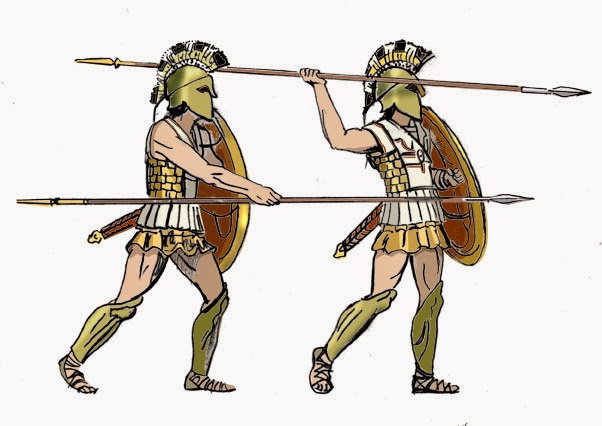
At this point, someone is inevitably shouting that bronze spears and steel spears are hugely different. They would, of course, be correct on a metallurgical level. However, I argue that for the user, the physical movements and tactics remain quite similar. This is widely supported by period iconography displaying consistent hand positions, postures, guards, and combat situations throughout the centuries.
Examples from iron-, midle age and hellenistic sources
Stating that the movements and materials remain similar does not, of course, mean there are no changes. Yet, because this online course focuses on movement and analyzing material reality, I argue that what you learn will work well outside of a strictly Iron Age setting.
When we developed the material that then became thisonline course, our two primary ingredients were the study of historical iconography and the study of reconstructed shields and spearheads. The third key ingredient was actively using physical reproductions of these weapons to interpret the movements depicted in the art. We approached this after years of training with a spear and shield in various contexts—including HEMA, LARP combat, and reenactment combat. Each of these provided a different rule set and combat context, filling our contemporary bodies with a deep, intuitive understanding of how to move with this (pre)historic weapon combination.
Even so, there was still much to learn before the movements seen in historical iconography felt comfortable and natural. For example, the main skill I still lacked in 2017 was spear throwing. Yet, it was already clear to me in theory that the throw is absolutely essential for interpreting the over-arm grip seen extensively, for example, in theBayeux Tapestry.
A major breakthrough regarding material reality occurred when we discovered how sharp spear tips actually interact with shields, a finding we finally shared in a2021 video. From there, it took two years to develop a system that aligned with historical iconography while fully utilizing what the physical reality of the weapons had revealed.
By this point, I had tested these concepts extensively during sparring sessions at the Greywolves reenactment group's trainings. I restricted myself to almost exclusively using this one style to see if it truly held up in practice. Alongside this physical testing, we designed specific simulators for the spears and shields (you can read more about them at the end of an older blog post here: https://www.hirdmenn.com/2022/11/the-martial-art-around-center-grip.html ). Ultimately, we developed enough practical skill to successfully challenge opponents who fought aggressively with a sword or axe and shield.
The End Game!
At this stage, we were ready to see if our hard work would pay off. To pressure-test our material, we travelled to international events like HEMAC Dijon in France and Hevrike in Trelleborg, Denmark. We also hosted our own events, such as the "Weekend with Spears" in Pukkisaari, Helsinki, and visited the Birka Viking Center for an event hosted by Roland Warzecha.
I am proud to say that our system held up flawlessly under pressure testing. Seasoned martial artists and experts have given us glowing testimonials—you can read a few of them below:
I (Arttu) used AI to combine these testimonials as I wrote this on my phone and it shows... We will refine this soon (I hope). The testimonials are real! They are from people we hugely respect! The pictutres are their real faces.
One great benefit of traveling, teaching and event organising was that we needed to develop pedagogical framework on teaching the shield and spear fighting. Three training schemes were developed to get our students to strong level on spear and shield fighting.
First we focused on how to train and develop the bodily skill of moving while using two weapons (shield and spear) at the same time. Second aim was to share the combat in to frameworks that required different sets of skills and styles of movement. We called thisthe four distances frameworkand finally ended up with a system to naturally move between these frameworks.
As the last huge challenge in learning combat is that combat is always different because all opponents are different. So instead of precise "if this then that style" we needed to develop a sort of nonlinear way of teaching reacting and quick decision making. For that we developed a system of drills we consider to cover the main areas of spear and shield combat. We believe this is why we have had such a great set of testimonials. It is not just that the material is well researched, but that the learning actually takes place and just after a weekend's class people feel confident when fighting with spear and shield. This is also why (I believe) Mr Warzecha wanted us to create the online course for the Dimicator scool.
The Course is ready! One can still get it whit huge 41% discount using this link:
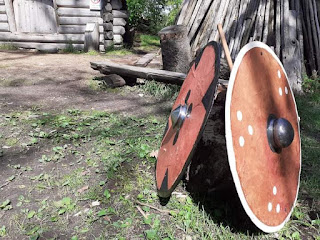
We have build two shield with similar construction. Both are made just like the one we named Fat little sister , with the exception that the other ( Skinny brother ) is made of 6 mm thick planks and the fat one is made out of 10 mm thick planks. Read about the construction of the Fat little sister from this blog post: https://hirdmenn.blogspot.com/2022/01/fat-little-sister-making-of-sturdy.html The black paint is on the 6 mm thick shield and the white paint on the 10 mm thick shield. Both are of spruce tree from the same order, so probably of the same age, maybe even from the same tree. The glueing was done the same way for both boards using same hide glue. Both have tanned leather facings from the same manufacturer. Both have raw hide edging from the same leather. The only difference is that the skinny one is painted with black iron oxide paint and the fat one has white chalk paint on it. Both are thinned down to 3 mm thickness on the edge, but the skinny one is shaved fr...
The preparation of our first shield was a long process. It took a lot of studying and this is a version Arttu was most interested in building. The preference was to make as light and agile a shield as possible. It is made of radially cut spruce. The boss is made of gnarl, the handle is ash, and the raw hide is deer. The planks are 6 mm thick in the middle of the shield and about 3 mm thick on the edge. The board Radially cut planks were a huge problem and we made some ourselves, but those turned out just a bit too thin and ended up becoming scabbards instead. We managed to buy radially cut planks from Fiskarssin saha . These enabled Arttu to make the board. Originally tried from pine Self made planks came 3-5 mm thick :( From Fiskarssin saha (Finnish company) After using a circular saw Then there was some simple gluing with hide glue. Clamps.... ...an...
It's been 12 years of training with a one handed spear for me (Arttu). Mostly I have trained weekly in summer time, but few years around the year. I started, and still continue, training with soft headed weapons in Finnish boffering scene. Also trained two handed pole weapons in HEMA context and one handed spear in Finnish reenactment scene. It took me 10 years before I became comfortable using a spear in the grip that is known as the overarm grip. Underarm grip (left) and overarm grip Bef ore this I became ok with using the underarm grip. Here is a video of an accuracy drill. During my 10 year training I learned the sliding strike and to hold a long spear from the end of the shaft. I did not become comfortable in the overarm grip before I trained to throw the spear. (Here is an old, worst quality, training montage video .) There is a forever ongoing discussion about the grips that goes on in the armchair generals discussions of one handed spear fighting. To me the...



Comments
Post a Comment